
Mighty Buildings Site Prep & Utilities: The Fontana Owner’s Guide
We stock and install Mighty Buildings-compatible site prep and utility connections in Fontana, with typical installed pricing running $3,200-$7,800 depending on utility complexity and existing infrastructure. Most parts are available same-day, and we carry Mighty Buildings-specific connection kits, trenching specs, and utility stub-out hardware on our trucks. Owners usually discover a failure when their unit arrives on-site and the pre-installed utility connections don’t mate with city infrastructure, or when water pressure tests fail because the original trenching depth didn’t account for Fontana’s expansive clay soils shifting over a single rainy season.
Which Mighty Buildings Models This Applies To
Mighty Buildings produces two primary product lines that reach Fontana properties: the M Series (single-module units, typically 350-700 sq ft) and the B2 Series (two-module configurations, 800-1,200 sq ft). The site prep and utility specifications differ meaningfully between them. M Series units ship with a standardized utility stub-out package - 3/4-inch water, 2-inch sewer, and 1.5-inch electrical conduit - all terminating at a single connection point on the module’s street-facing wall. B2 Series units split these across two modules, requiring a junction box and coordinated trenching that the M Series avoids.
To identify your specific configuration, check the metal data plate inside the utility closet; the “Site Package” field lists either SP-M1, SP-M2, SP-B2A, or SP-B2B. SP-M2 indicates a dual-water configuration (potable plus fire sprinkler) that many Fontana owners don’t realize they have until inspection. The OEM Mighty Buildings connection hardware uses proprietary flange patterns on the water and sewer stubs; aftermarket equivalents from Watts or Charlotte Pipe fit but require adapter rings we machine in-house. We stock both OEM and quality aftermarket options because OEM lead times currently run 8-12 weeks, and most Fontana owners can’t hold a crane date that long.
Signs Your Mighty Buildings Site Prep & Utilities Is Failing
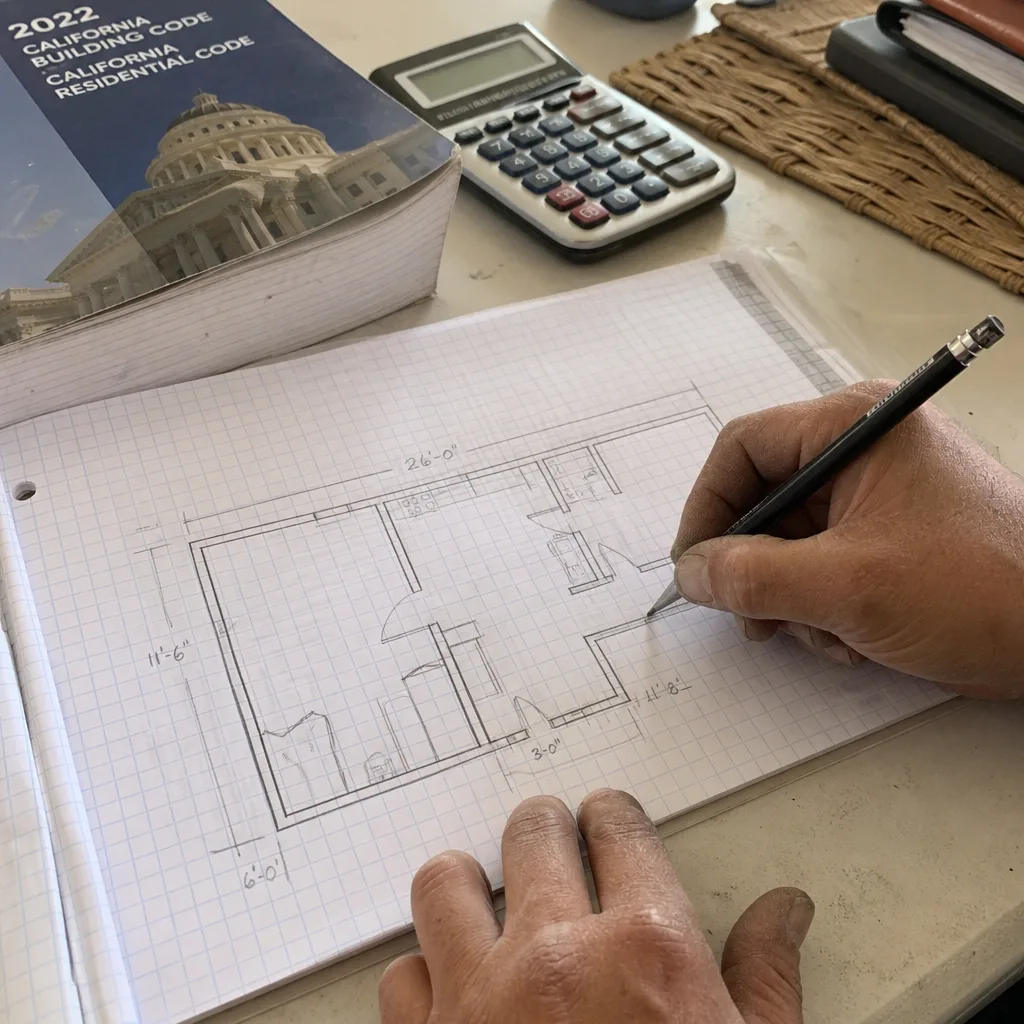
- Water pressure drops below 40 PSI at any fixture. Fontana’s municipal supply delivers 60-80 PSI at the meter; if you’re seeing 35 PSI at the kitchen sink, the likely culprit is a partially collapsed PEX run in the trench, crushed by soil movement during our wet winters and dry summers. The expansion-contraction cycle in Fontana’s clay-heavy soils is hard on rigid utility connections.
- Sewer backup or slow drainage in all fixtures simultaneously. This points to a belly or separation in the 4-inch ABS lateral between your Mighty Buildings unit and the city main. We’ve found this most often in Southridge and Sierra Lakes installations where the original trench bed wasn’t compacted to 95% standard Proctor density - the pipe settles, creating a low spot where solids collect.
- Electrical conduit pulling away from the module wall. The Mighty Buildings spec calls for a flexible expansion joint at the structure penetration; if this was omitted or has degraded, Fontana’s thermal cycling will literally walk the conduit out of its fitting. You’ll see a gap between the EMT and the weatherhead, sometimes with visible arcing marks.
- Gas odor or pilot light failures in propane configurations. Mighty Buildings units in Fontana’s non-gas-grid areas use LP systems with a buried tank pad and copper tracer-wire-protected supply line. The tracer wire corrodes at the anode-less clamp points; without cathodic protection, the copper line pits and leaks. This is not a homeowner diagnostic - it’s an immediate evacuation and utility call.
- Foundation leveling bolts backing out or cracking the perimeter grade beam. The Mighty Buildings M Series sits on a steel frame with adjustable leveling bolts at 48-inch centers; if these weren’t torqued to 85 ft-lb at install, Fontana’s expansive soils will work them loose in 18-24 months. You’ll see gaps under the base rail or diagonal cracks in the site-poured grade beam.
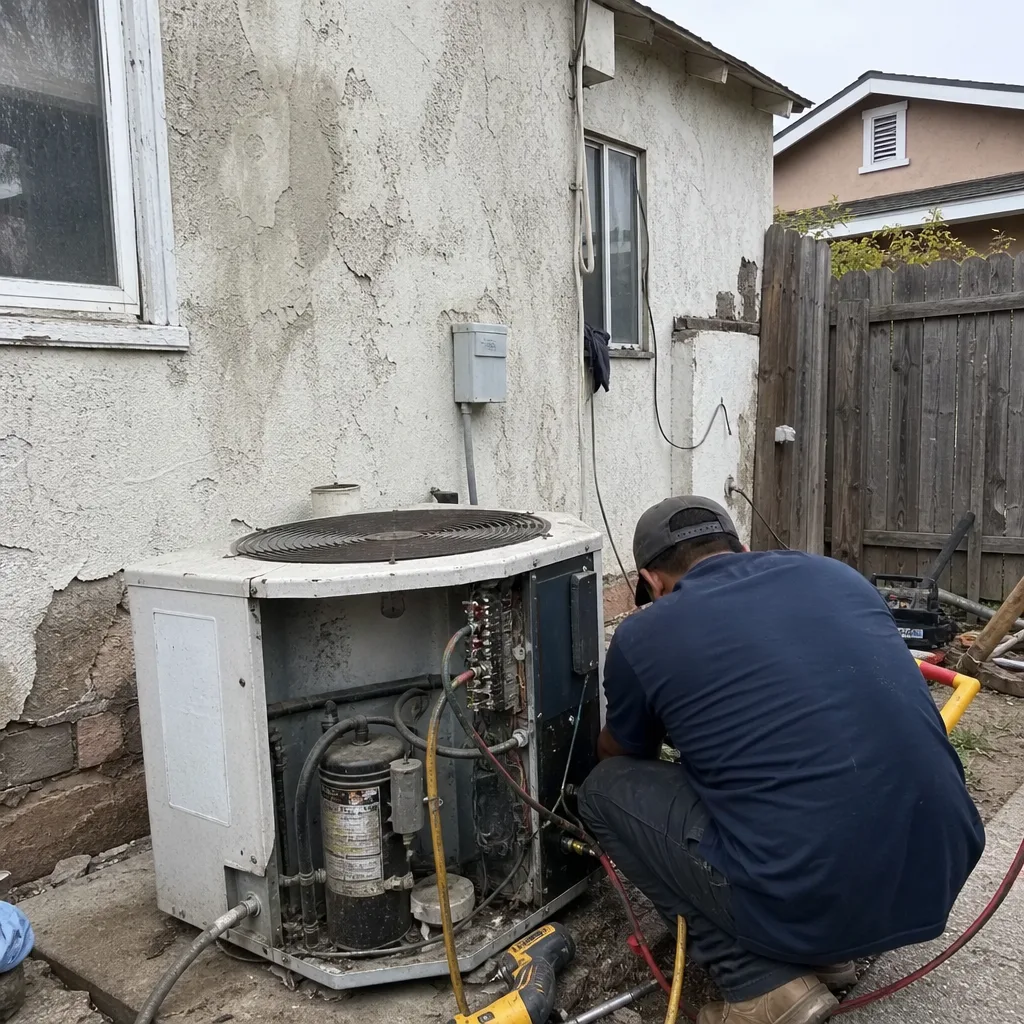 Before
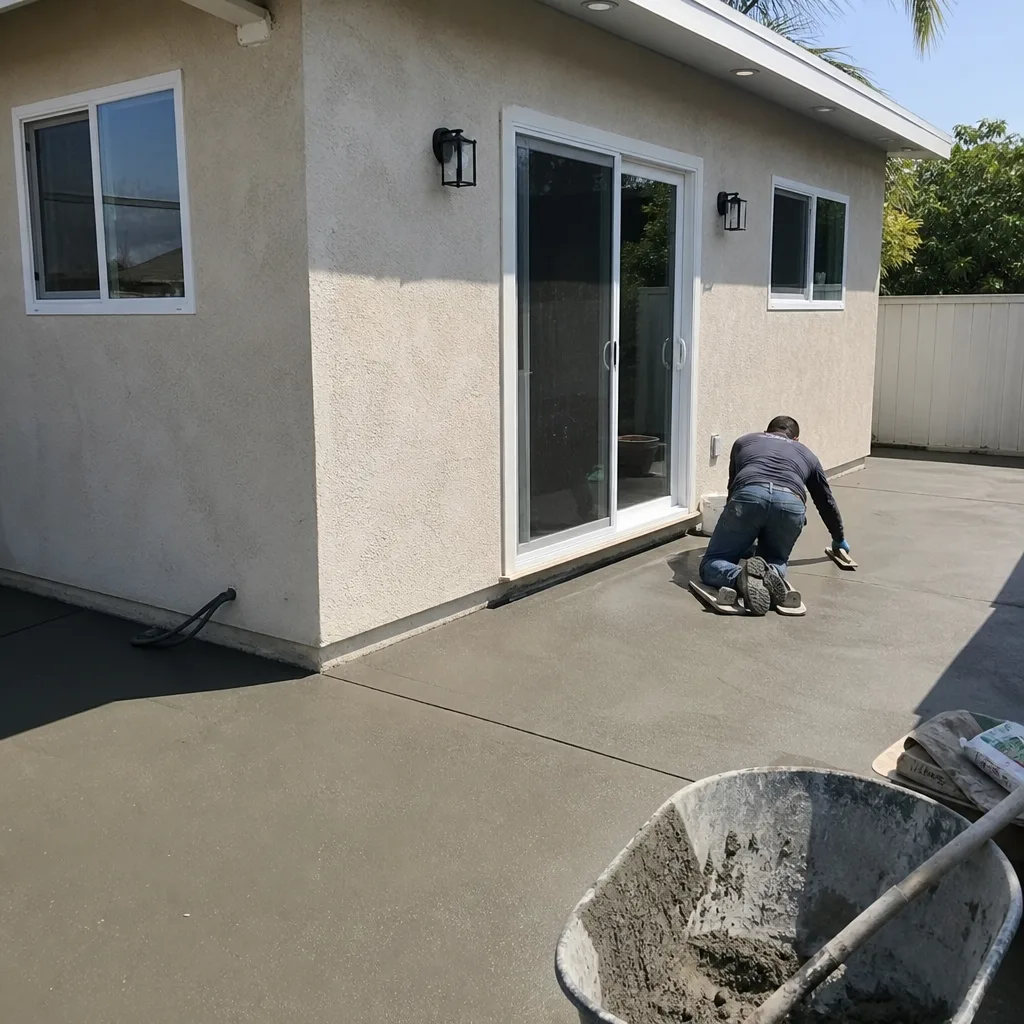 After
AfterReplacement Cost & What’s Included
| Component | Typical Range (Installed) | What Drives the Spread |
|---|---|---|
| Water service replacement (meter to module) | $1,800-$3,400 | Trench length, asphalt restoration, dual-water (SP-M2) vs. single |
| Sewer lateral replacement | $2,400-$4,600 | Depth to city main, traffic control if street crossing required, liner vs. open trench |
| Electrical service upgrade/replacement | $2,800-$5,200 | Ampacity (100A vs. 200A), overhead vs. underground, SDG&E coordination timeline |
| Gas system repair/replacement | $1,600-$3,800 | LP tank relocation, line length, automatic vs. manual changeover |
| Foundation leveling and grade beam repair | $1,400-$2,800 | Number of piers required, epoxy injection vs. section replacement |
| Full site prep & utilities package (M Series) | $4,200-$6,800 | Existing conditions, utility locations, soil report requirements |
| Full site prep & utilities package (B2 Series) | $5,800-$7,800 | Dual-module coordination, junction box complexity, longer trench runs |
These ranges include parts, Fontana permit fees, trenching and backfill, compaction testing, and final utility activation. Under Haven Standard Clause 1, every project receives a written price before work starts - the number on the page is the number we defend, or we explain in writing exactly why it moved. We pull all permits and schedule inspections; our documented photo record shows trench depth, pipe bedding, and compaction test results, not just “before and after.” Workmanship warranty is 365 days on all site prep and utilities, backed by our Done Right Promise in writing.
DIY or Call Us?
There’s a clear line here. An owner can safely verify their Mighty Buildings model number, photograph the data plate, and check whether utility shutoff valves operate freely - that’s useful information to bring us. What goes wrong is everything underground and anything pressurized. Fontana requires a licensed C-34 plumber for water and sewer work beyond a fixture shutoff; electrical service upgrades demand a C-10 and SDG&E coordination; gas work requires a C-36 and pressure testing with a calibrated gauge. The soil compaction and trench bedding specs in Mighty Buildings’ installation manual - 6 inches of 3/4-inch crushed rock, 95% standard Proctor, verified with a nuclear density gauge - aren’t achievable with hand tools and good intentions.
We’ve been called to three Fontana properties in the past two years where a well-meaning homeowner’s trench collapsed during a rain event, or where a self-installed water line failed the pressure test and the crane date was blown. The cost to fix those situations ran 40-60% above the original quote because of emergency scheduling and rework. For Mighty Buildings units specifically, the crane schedule drives everything; a utility failure on crane day is a $2,500-$4,000 crane standby charge, minimum. Call (909) 637-3715 and we’ll scope it properly the first time.
FAQs
In Fontana’s climate, properly installed water and sewer laterals last 25-40 years; electrical conduit and gas lines typically see 20-30 years before significant maintenance. The limiting factor is usually soil movement, not material degradation - we’ve replaced 6-year-old connections in the Southridge corridor where expansive clay wasn’t properly mitigated at install, and we’ve seen 35-year-old copper still holding pressure in older Fontana neighborhoods with stable, decomposed-granite soils. Call (909) 637-3715 for an assessment of your specific site conditions - estimates are free.
Partial repair is often possible for isolated failures: a single leaking water joint, a localized sewer belly, or a cracked section of grade beam. We don’t recommend spot repairs when the failure pattern indicates systemic issues - multiple leveling bolt failures, repeated pressure drops, or trench settlement along the full run. In those cases, replacement with modern materials (PEX-A with expansion fittings, HDPE sewer liner, epoxy-coated rebar in grade beams) costs more upfront but eliminates the callback cycle. We document both options in writing with a 10-year cost projection before you decide.
A typical M Series utility replacement requires 4-6 working days: Day 1 for utility locates and trenching, Day 2-3 for pipe installation and pressure testing, Day 4 for backfill and compaction, Day 5-6 for final connections and inspection. B2 Series work runs 6-9 days because of the dual-module coordination. Weather and SDG&E scheduling can extend this; we build realistic timelines into our written scope, not optimistic ones. The crane date stays protected because we don’t start utility work without confirmed material delivery and inspector availability.
We stock the full range of Mighty Buildings-compatible connection hardware on our Fontana trucks: SP-M1 and SP-M2 water stub kits, B2 Series junction boxes, OEM flange adapters, and the aftermarket equivalents we machine to match. We don’t stock the modules themselves - nobody does, they’re factory-ordered - but we carry everything that connects a delivered Mighty Buildings unit to Fontana’s infrastructure. If your specific configuration requires a non-standard fitting, we typically source it within 48 hours through our Inland Empire supplier network.
Ellery ADU Studio Fontana is an independent service provider; we are not affiliated with Mighty Buildings. We specify and coordinate their systems alongside Abodu, Cover, and Dvele under our single-contract design-build model.
Ready to get your Mighty Buildings unit properly connected? Call (909) 637-3715 to schedule your free estimate. We’ll review your site conditions, confirm your model configuration, and deliver a written price with no obligation - per Haven Standard Clause 1, as always.
Written by Nadia Ellery, Owner, Ellery ADU Studio Fontana at Ellery ADU Studio Fontana, serving Fontana and nearby areas.